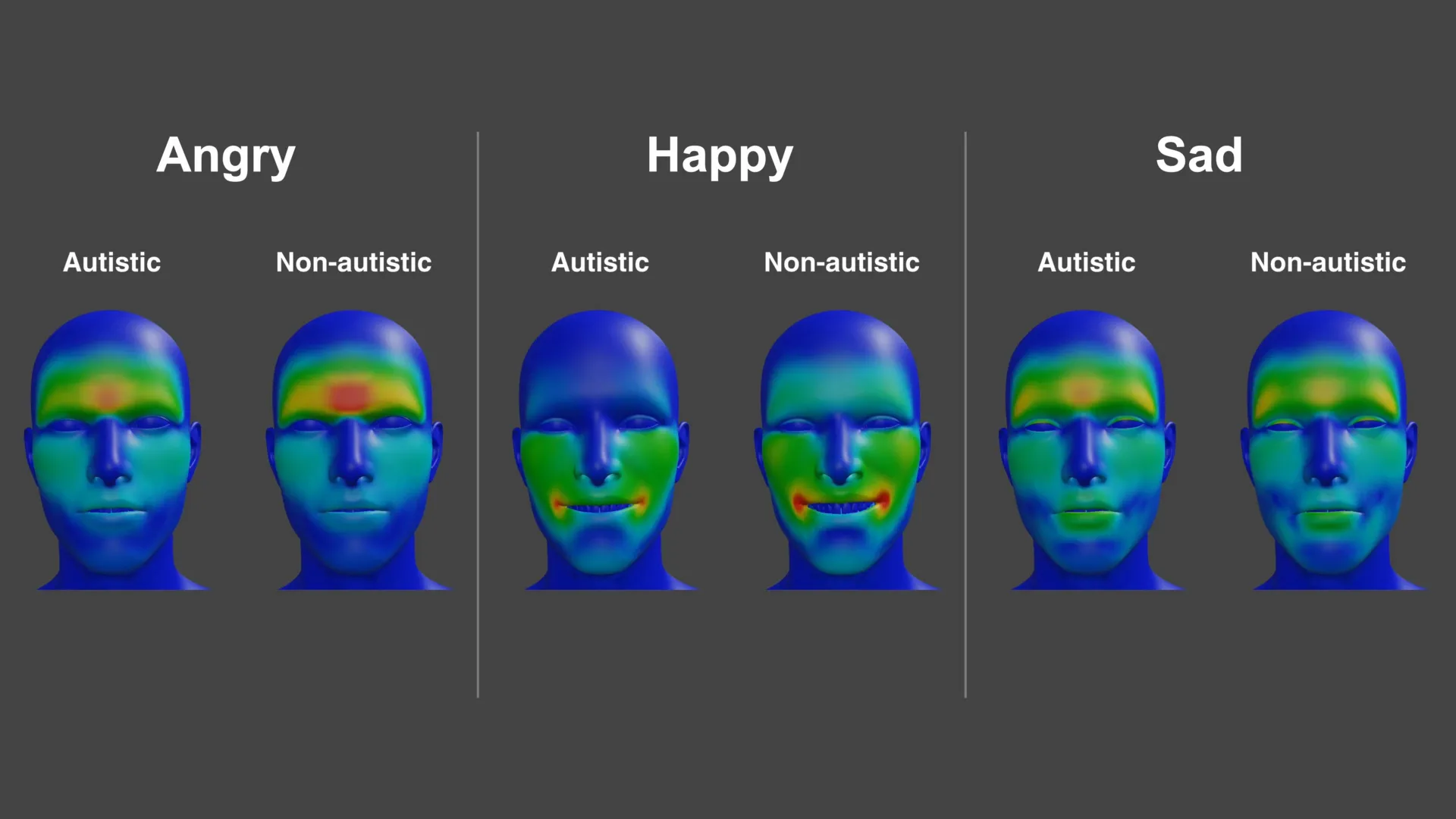
A new study suggests autistic and non-autistic adults can express the same basic emotions with different facial movement patterns, a gap that may contribute to frequent misunderstandings in everyday interactions. Researchers say the findings support a growing view that communication difficulties can be two-way rather than rooted in a lack of emotion.
Working with participants in both groups, scientists used detailed facial motion tracking to build a high-resolution map of how expressions for emotions such as anger, happiness and sadness are produced. The project generated more than 265 million data points, creating a large library of facial movements designed to capture subtle differences in how expressions form.
How the researchers measured expressions
The study involved 25 autistic adults and 26 non-autistic adults, who together produced close to 5 000 expressions under different conditions. Participants were asked to display emotions while matching facial movements to sounds and while speaking, allowing the team to examine how expressions change across contexts.
Across tasks, autistic participants showed a wider range of unique expression patterns than their non-autistic peers, the researchers reported. For anger, the autistic group relied more on mouth movement and less on eyebrow movement, while happiness tended to be expressed with a subtler smile and sadness showed a different configuration around the upper lip.
Alexithymia adds another layer
The team also examined alexithymia, a trait involving difficulty identifying and describing one’s own emotions that is more common in autism than in the general population. Higher levels of alexithymia were associated with less clearly defined expressions for anger and happiness, which can make the displayed emotion appear more ambiguous.
Lead researcher Connor Keating said the differences were not only about what expressions look like, but also how smoothly they are formed over time. Senior author Jennifer Cook argued the results fit a communication mismatch model, where both autistic and non-autistic people can misinterpret each other’s emotional signals.
The research was published in Autism Research and was supported by the UK Medical Research Council and the EU Horizon 2020 programme. The authors said the growing dataset could help improve future studies of emotion recognition, as well as training approaches aimed at reducing everyday misreadings.
Leave a Reply