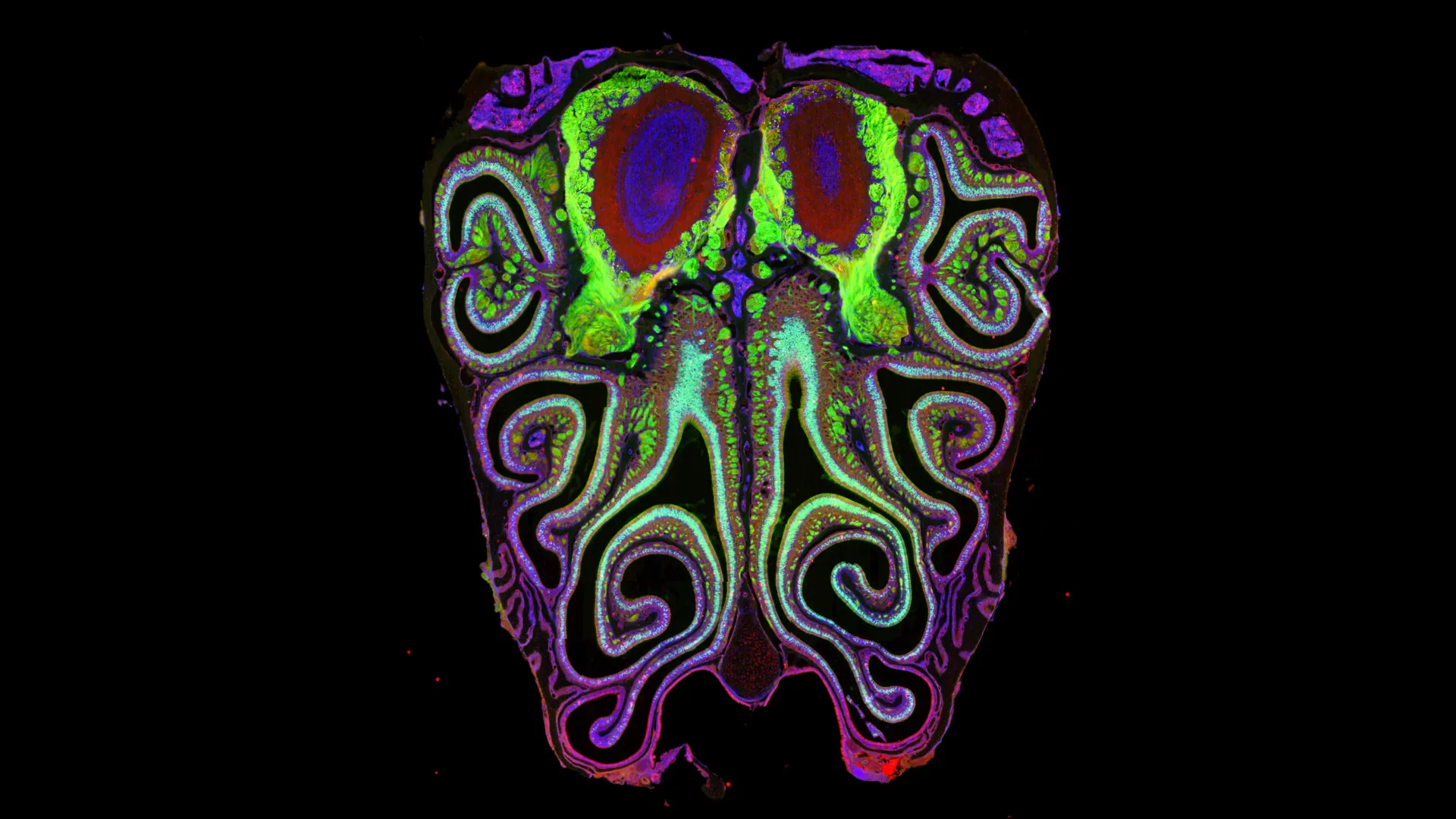
Smell helps people detect hazards, shapes flavor, and ties closely to memory and emotion, yet its underlying biology has remained harder to map than other senses. New research in mice now outlines a detailed layout of where different smell receptors sit inside the nose.
The study, published in Cell on April 28, describes the first high-resolution spatial map for more than 1 000 types of olfactory receptors. Researchers say the work challenges the long-held view that these receptor-carrying neurons are arranged largely at random.
A hidden order in olfaction
Instead of a scattered pattern, the team found that olfactory sensory neurons form organized horizontal bands across the nasal tissue. These stripes overlap in a consistent way, grouping neurons by the receptor type they express.
That organization appeared highly reproducible across animals, suggesting it is a stable biological blueprint rather than a quirk of individual development. The researchers also report that the nasal map aligns with corresponding maps in the olfactory bulb, the brain’s first processing hub for smell.
How the map may form
To build the atlas, scientists analyzed about 5.5 million neurons collected from more than 300 mice. They combined single-cell sequencing, which identifies receptor identity, with spatial transcriptomics, which preserves information about each cell’s location.
The team also points to retinoic acid, a molecule known to regulate gene activity, as a key organizer of the pattern. When researchers altered retinoic acid levels, the position of the receptor stripes shifted up or down, indicating a developmental control signal.
Why it matters for smell loss
Loss of smell has gained wider attention in recent years, including from post-viral cases, and it can affect safety, nutrition, and mental well-being. Researchers argue that restoring olfaction will require understanding how receptor neurons are positioned and connected to the brain.
The study’s authors say a clearer map could help guide future efforts to repair damaged smell circuits, including work on cell-based therapies and other interventions. They also note that an important next step is testing whether a similar receptor organization exists in humans.
Leave a Reply