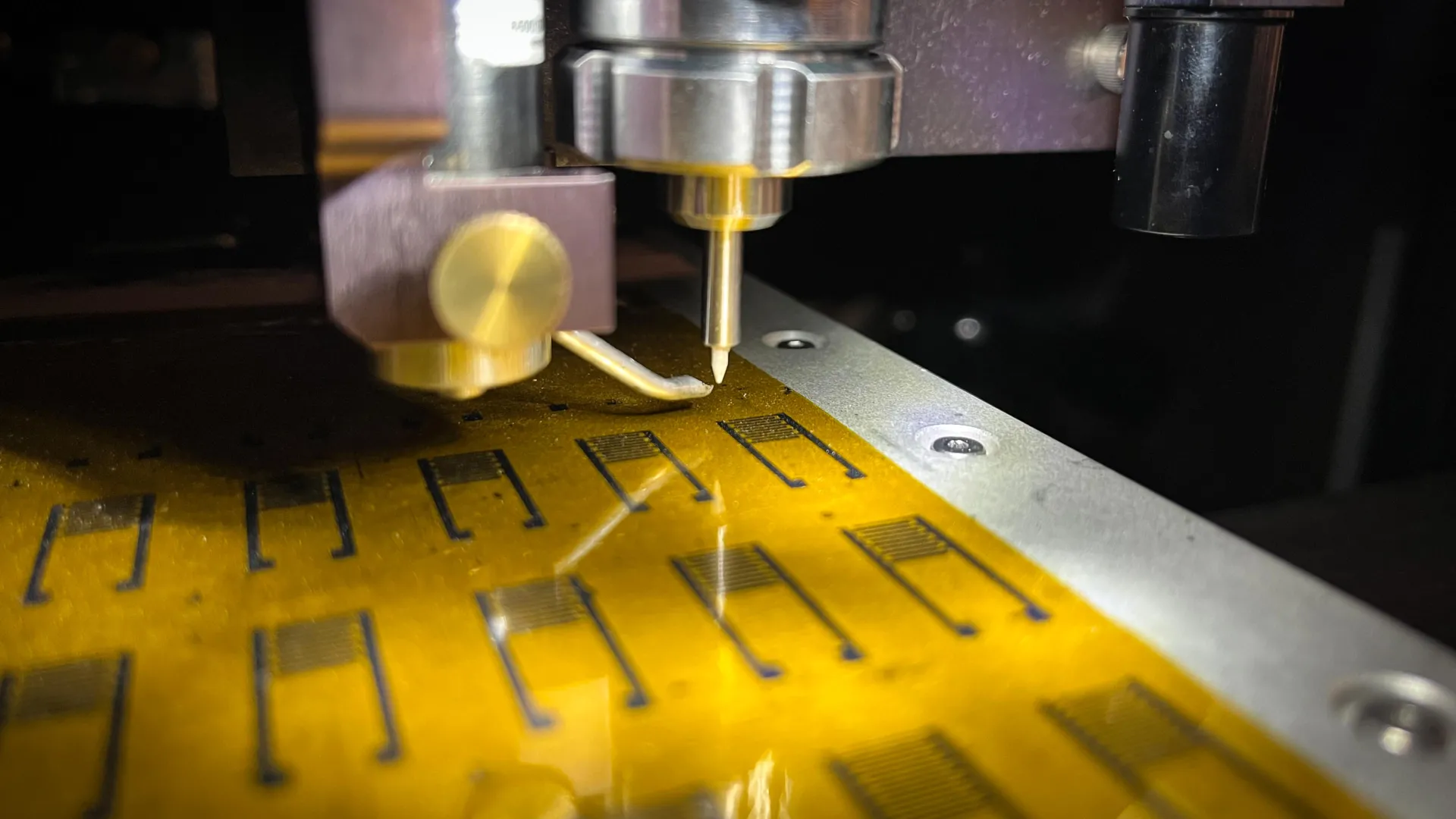
Engineers at Northwestern University have developed printed artificial neurons that can communicate with living brain cells, a step toward closer integration between electronics and neural tissue. In tests on mouse brain slices, the devices generated electrical spikes that activated biological neurons.
The work, reported in Nature Nanotechnology, focuses on matching the timing and shape of real neural signals rather than producing simplified pulses. That compatibility matters because neurons respond not just to strength, but to precise patterns that govern how circuits switch on and coordinate.
How the printed neurons work
The team fabricated the devices using aerosol jet printing, depositing electronic inks onto flexible polymer substrates. The inks use nanoscale flakes of molybdenum disulfide as a semiconductor and graphene as a conductor, materials commonly studied for next-generation electronics.
A key twist is how the polymer is handled after printing. Instead of removing it entirely, researchers partially decomposed it so that electrical current could further reshape the material, creating a narrow conductive filament that produces a neuron-like firing response.
Why brain timing is hard to mimic
Many earlier artificial neurons struggled to hit biologically relevant speeds, producing spikes that were either too slow or too fast to reliably engage real tissue. Northwestern’s results suggest the printed devices operate within a temporal window that better aligns with the dynamics of living neurons.
To test real-world interaction, the researchers delivered the artificial spike patterns to slices of mouse cerebellum in collaboration with neurobiologists. The recorded responses indicated that natural neurons fired in step with the artificial inputs, triggering downstream circuit activity.
Implications for AI and neuroprosthetics
The advance could support future brain-machine interfaces and neuroprosthetics that require stable, low-power communication with the nervous system. Flexible, printable electronics are also attractive for implants because they can better match soft tissue compared with rigid silicon components.
Researchers also point to energy-efficient computing as a longer-term goal, as brain-inspired hardware could reduce power demands compared with conventional digital systems. By generating richer, more neuron-like signals per device, the approach may reduce the number of components needed for complex neuromorphic tasks.
While the experiments were performed on brain slices rather than in living animals or people, the study offers a clearer demonstration of functional compatibility between artificial neurons and biological circuits. The next hurdles include long-term stability, safe packaging for biological environments, and scaling the technology into larger, controllable networks.
Leave a Reply