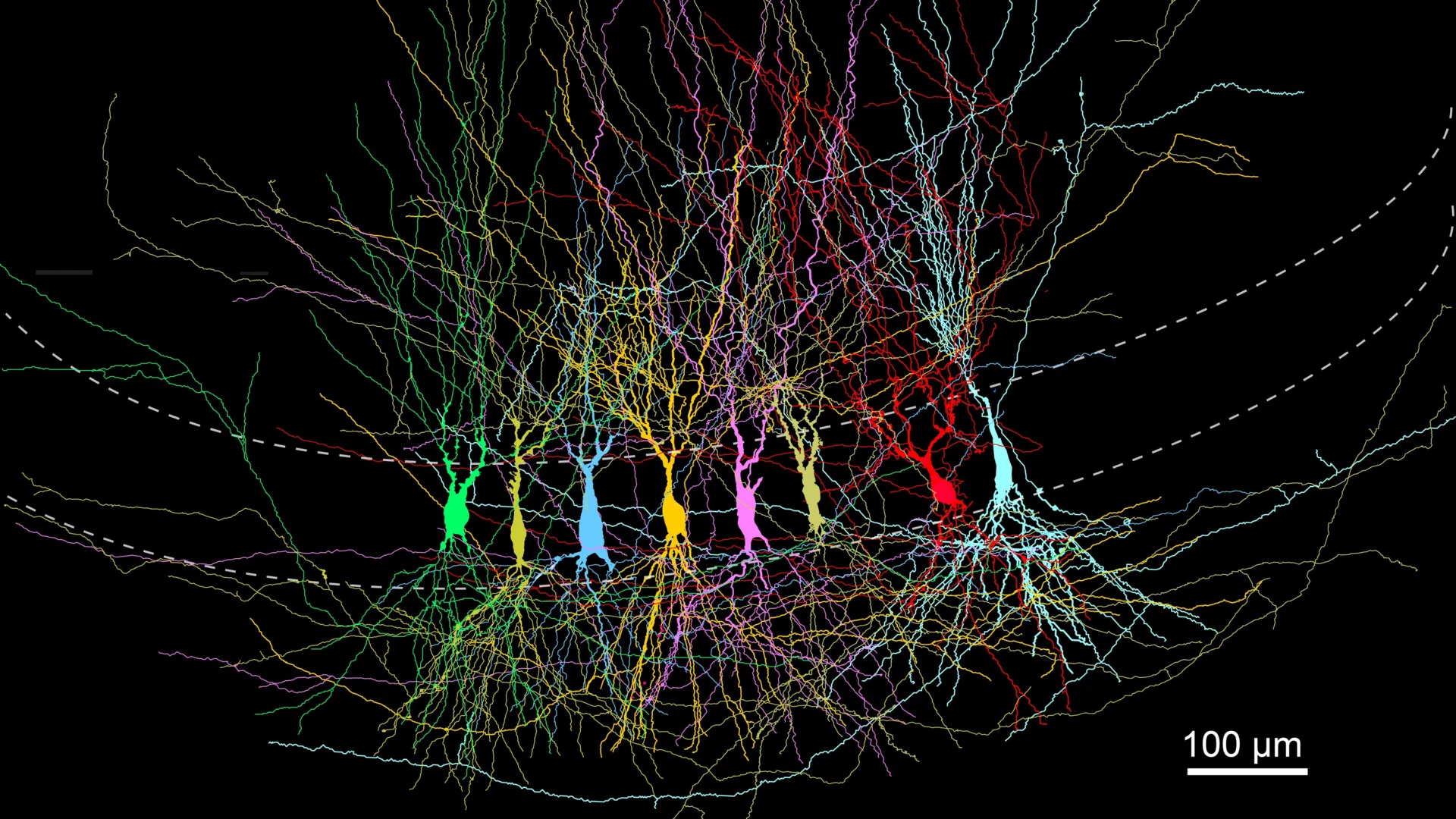
The hippocampus, a brain region essential for forming memories and mapping space, may develop in a way that challenges the long-held idea of the mind as a blank slate. New research from the Institute of Science and Technology Austria suggests key memory circuits begin life with unusually dense wiring that is later trimmed and refined.
In a study published in Nature Communications, scientists examined how a major hippocampal network changes after birth in mice. The team focused on CA3 pyramidal neurons, cells widely seen as central to storing and retrieving memories.
How the CA3 circuit develops
Using patch-clamp recordings and high-resolution imaging, researchers compared the CA3 network across early postnatal stages, adolescence, and adulthood. The methods allowed them to measure tiny electrical signals and map how strongly neurons were connected at different ages.
The results pointed to an early-life circuit that is highly connected and seemingly random, followed by a gradual shift toward fewer but more organized links. Rather than adding connections over time, the network became more efficient by losing many of its initial ones.
Pruning may boost memory efficiency
Lead researcher Peter Jonas said the pattern fits a pruning model in which the system starts full and then becomes streamlined. The researchers argue that an initially exuberant network could help the hippocampus quickly integrate different kinds of sensory information into usable memories.
If the brain started with far fewer built-in links, the team notes, neurons would first need more time to find and connect to each other, potentially slowing early information processing. The study adds to broader evidence that brain development often involves overproduction of connections followed by activity-dependent pruning.
While the work was conducted in mice, the hippocampus is highly conserved across mammals, making the findings relevant to ongoing debates about how genetics and experience shape learning. The authors say future research will need to clarify what signals drive which connections are kept or removed, and how this process relates to memory performance.
Leave a Reply