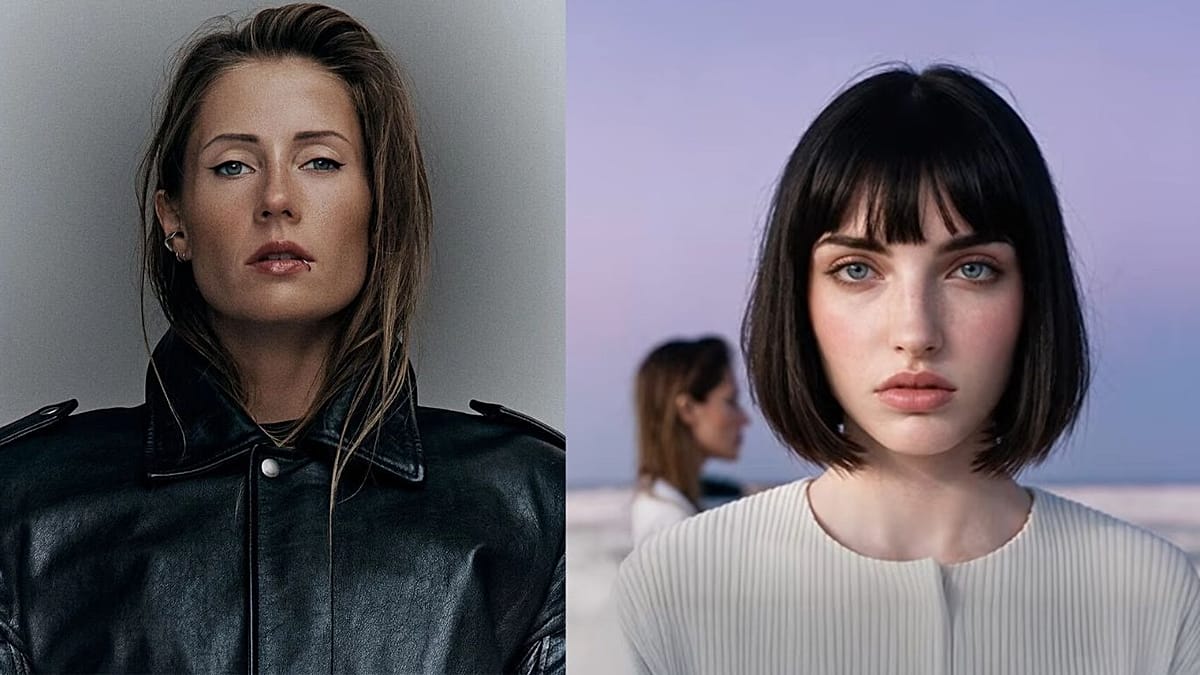


The international DJ released the EP Azadi with NAVA, a virtual AI singer, to represent Iranian women banned from performing publicly, but techno star’s choice has not gone down well with some of her fans.
What if the undisputed queen of global techno crossed over to the “dark side”? That is what many people thought when on Thursday 5 November (and even earlier, to be fair) Charlotte de Witte, the 34-year-old Belgian DJ and record producer who boasts 6.5 million Instagram followers, released her new EP.

ADVERTISEMENT
ADVERTISEMENT
Azadi (in Persian, “freedom”, a word we came to know during the protests in Iran in 2022), released on her own label KNTXT, contains three tracks (Azadi itself, Omid, which means “hope”, and Tales of the Desert) with the acid techno sound that has always set her apart, as do the 140 BPM, but this time with a rather unusual vocalist.
De Witte, voted the world’s No. 1 techno DJ for the seventh year in a row in the DJ Mag Top 100 DJs 2026 ranking, has in fact used an AI singer for the first time. This is NAVA, developed by British-Iranian artist Farbod Mehr.
In an official statement, the artist said that “NAVA represents Iranian women who are forbidden to perform in public” and that the EP is conceived as “a small act of resistance”, with all proceeds donated to the NGO FEMENA, an organisation that supports women’s rights activists and feminist movements in the SWANA region and in Asia.
The EP is therefore not a record produced entirely by artificial intelligence, but a musical collaboration in which only the lead voice is that of a virtual singer.
Who is NAVA?
NAVA is a project created in 2025 by Farbod Mehr, a British digital artist of Iranian origin. The virtual singer was developed using artificial intelligence and her visual identity is inspired by Persian art and cultural tradition.
Mehr has said that his aim is to symbolically represent Iranian women, who cannot freely perform as solo singers in front of mixed audiences. One only has to think of the case of Parastoo Ahmadi, who in June was sentenced by a court in Qom to 74 lashes, a two-year travel ban and a two-year suspension from artistic activity. Her offence? Having posted a concert streamed on YouTube in December 2024, in which she performed without a headscarf and wearing a sleeveless dress.
Reactions from fans and experts
The intention is certainly good, but it has not been welcomed unanimously, as de Witte may have hoped. Her fan base has been extremely voiciferous with its criticisms. The decision to use an artificial voice to represent women who have been deprived of the possibility of expressing themselves through music has in fact raised numerous objections among electronic music fans.
Many are asking why the voice of a real person was not used. For instance, on Reddit one fan states: “I have completely stopped enjoying her music. There are other ways to give voice to Iranian women, without resorting to ‘an artist’ created by artificial intelligence”. For another fan the initiative is to be praised, but they believe she could have chosen a different path: “Apparently, artificial intelligence is supposed to represent Iranian women living under oppression, but is it really possible that there were no Iranian artists in the flesh to sing on the track?”
Some users also fear that normalising AI-generated voices could reduce professional opportunities for singers, backing vocalists and musicians, replacing human artistic performances with artificial tools.
Criticism has also come from within the Iranian techno scene. AliPink, a DJ and producer, a pioneer of the country’s underground scene and founder of the label Techno Tehran Records, has challenged the decision to rely on an artificial singer to represent Iranian women.
In a comment posted on Instagram and later picked up by the platform Tehran Herald, AliPink described as “deeply questionable” the idea that an artificial voice is needed to represent these women, stressing that there are already Iranian artists in the flesh, with talent and stories to tell.
AliPink has also questioned the very value of the project, adding: “There is a fundamental difference between raising awareness of the difficulties faced by Iranian women and using their struggles as a concept to promote music generated by artificial intelligence”.
There are, however, also those who defend the project, pointing out that if de Witte had used a real Iranian artist she would have put her at risk by having her sing those songs. One Instagram user commented under the post in which de Witte shared a preview of the EP before its official release: “Wow, as a Persian woman and artist, this really hits me deeply. People do not realise how much Iranian women have to fight, much harder, just to do what artists in other countries are free to do every day”. Another Instagram user wrote: “I have been waiting for this release, thank you Charlotte, for highlighting the voices of Iranian women, who are repressed by their government and denied the chance to express themselves creatively”.
The debate is therefore more complex than a simple clash between supporters and opponents of AI. For some, NAVA represents a missed opportunity to involve artists of flesh and blood directly, while for others it is a tool of expression and solidarity when there are no alternatives.
The thin line between creativity and copying
The story is part of a broader debate about the role of artificial intelligence in the music industry. In recent years, generative tools have become capable of creating voices, melodies and entire compositions, calling into question the relationship between human creativity, technology and intellectual property.
So far the music industry has mostly proceeded through self-imposed limits. For example, Spotify requires that every use of unauthorised voice cloning be explicitly flagged and is prohibited, while Bandcamp (a direct-sales platform for record producers) categorically bans music generated “entirely or largely” by AI. Since 2026, moreover, Beatport has refused to accept tracks for upload if they are deemed to be fully AI.
Charlotte de Witte’s decision to use an AI voice reignites a question that is now increasingly central in the music industry: whether, and what, space artificial intelligence should have in artistic creation? Above all, where does technological experimentation end and the replacement of human labour begin?
With Azadi, the Belgian DJ has taken this debate into a particularly sensitive area, that of freedom of expression and women’s rights. Whatever the intentions and the solidarity message behind the project, one crucial question remains: when we use artificial intelligence to give a voice to those who cannot speak freely, are we really giving their voice back to them or are we simply speaking in their place?
Read more



Leave a Reply